Key Takeaways
- When it comes to AI-generated code, it cannot be assigned to the public domain.
- Owning the code refers to having the legal right, technical access, and architectural control to take your app outside the AI tool.
- Assigning IP rights depends on the contract, unless it expressly assigns the rights to you.
- Third-party and open-source code are scanned, and you can generate both license code and reports simultaneously.
- You can run a 10-minute ownership test to evaluate IP and data-related confusion with the code.
- Nativly is an efficient AI tool that offers complete ownership of your code with the right IP and data address.
Under current copyright law, purely AI-generated code has no human author and cannot be copyrighted, meaning it often falls into the public domain.
However, it all depends on what type of app development platform you are using for app creation.
Buying an AI module can feel like adding a superpower to your software, until you ask who owns what happens behind the scenes.
The code may be generated in minutes, but the rights, the data flows, and exit options can shape your product for years.
This guide will help you to turn these questions into a practical checklist, helping you move from impressive demo to the informed decisions.
What Does “Owning the Code” Actually Mean for an AI Module?
Owning the code for AI modules means much more than just holding the repository files or having the legal license to the text. It means having the legal right, technical access, and architectural control to take your application outside the AI tool and pass it to developers.
Further, owning AI-generated code splits into two realities: legal copyright ownership and functional operational control.
Additionally, in the era of AI-generated and AI-assisted software, true ownership extends far beyond the legal profession. True ownership spans legal rights, operational transparency, and the ability to maintain and evolve the system independently.
Well, before discussing owning the code, you should know the complete guide to building enterprise apps with AI.
Now, let’s take you to the key questions that you should ask before owning the code.
IP Questions to Ask Before You Buy
Before you convert your app idea into reality with an AI, you may ask key questions, or you can get your doubts answered in the given questions list.
- Do I receive an assignment of all rights, or only a license?
It completely depends on the contract; unless it expressly assigns the rights to you, you generally receive only the license it specifies. Here, you receive a license, whose scope and restrictions are set by the agreement.
- Who wrote the code: AI only, or AI plus reviewed by engineers?
AI generates a large and growing share of modern software code, but human engineers remain the mandatory reviewers and quality gatekeepers. This code is generated by AI and further reviewed by the engineers.
- Is third-party and open-source code scanned, and can I get a license report or SBOM?
Yes, the third-party and open-source code is routinely scanned, and you can generate both the license reports as well as software bills of materials. The third-party and open-source code is scanned, and you can get a license report or SBOM.
- Does the IP indemnity cover AI-generated output? What are the carve-outs and the cap?
Yes, intellectual property (IP) indemnification can cover AI-generated outputs, depending heavily on the vendor, your tier of services, and whether you meet strict usage conditions. Check whether the IP indemnity expressly covers AI-generated output, which exclusions apply, and whether the liability cap limits that protection.
- Could other customers receive identical or similar output?
Yes, other customers can receive identical or similar output depending on the systems and how it is configured. The output can vary because of AI and large language models, as well as software and reporting tools. The outputs are identical due to deterministic systems and locked AI settings.
- Can I export a complete, buildable repository with no proprietary runtime?
Yes, you can export a complete, buildable repository with zero proprietary runtime from many modern development and low-code/no-code platforms. Here, you should confirm that you can export the complete source repository and all the required dependencies, and build and run it without the vendor’s proprietary runtime.
- Do the vendor’s engineers and contractors assign their IP to the vendor and, through it, to me?
You should verify that the vendor’s engineers and contractors have signed agreements assigning their work to the vendor, and that the vendor’s agreement transfers or licenses those rights to you.
- What happens if the vendor is acquired, changes terms, or shuts down? (Ask about escrow or a transition clause.)
When a critical software or service vendor undergoes a change-like an acquisition, a shift in terms, or a complete shutdown- it creates significant operational and legal risks for your business.
- What IP representations will the vendor give for my investor or acquirer’s due diligence?
During intellectual property due diligence, a buyer or investor will require the target company to make a series of formal statements of fact within the definitive transaction agreement. Additionally, the vendor must represent that the IP should be cleanly own, have properly protected and possess the legal right to use all IP required to run the business.
Data Questions to Ask Before You Buy
Before you own the code, you can ask the vendor the following types of questions:
Q1. What data does the module collect, receive, generate, or access—including prompts, source code, customer data, and outputs?
The specific data a module collects, receives, generates, or accesses depends entirely on the purpose of the module. Here, the module may collect, receive, generate, or access prompts, source code, customer data, and outputs, depending on its features and the data flow.
Q2. Will any of my data be used to train, fine-tune, or improve the vendor’s or a third party’s models?
It depends on the vendor’s terms and settings; therefore, confirm in writing whether the data is excluded from training, fine-tuning, and model improvement by the vendor and its third-party providers.
Q3. Who can access the data, including the vendor’s staff, contractors, and model or cloud providers?
Access to data is possible by third parties, including a vendor’s staff, contractors, and model or cloud providers. Further, when building an application, the data split can be among who owns the app, who uses the app, the AI platform provider, and underlying database services.
Q4. How long is data retained, where is it stored, and how is it protected?
The prompt logs and app interactions are often stored for 30 days to 55 days for abuse and safety monitoring. Similarly, the standard API or the developer tiers typically get stored for 30 to 55 days. The data is used for safety reviews, abuse monitoring, and to check for data residency.
Q5. Can I control retention and opt out of training or secondary use?
Yes, you can control data retention and can opt out of training or secondary use, though the exact process and default settings vary by provider. The key limitations to be kept in mind are that opting out is not zero-retention; consensus on forum discussion.
Q6. Can I require deletion of my data, including backups, when the contract ends?
Yes, you can require deletion of the data, including backups, only if the contract gives you that right. However, there are three major roadblocks to “total deletion” in AI, including the model training trap, the shadow data trail, and the backup retention paradox.
Q7. Which sub-processors receive data, and will I be notified if they change?
The sub-processors may include AI model/API providers or vendors hired by a primary data processor for handling, storing, and transmitting personal data on behalf of the data controller. The specific sub-processor that receives data typically depends on the individual service or platform you are using, as each company maintains its own distinct vendor list.
Q8. Do I retain ownership and control of the data and AI outputs, and can I export them in a usable format?
In most of the cases, you retain legal ownership of your data inputs and AI outputs under the major platform terms, but the key terms may reserve rights that is already written in the conditions of each app-building platform. You should confirm that the contracts, as written in the building platforms, grant you control and let you export your data and outputs in a complete and usable manner.
Q9. What happens to data if there is a security incident, legal request, or change in vendor ownership?
The impacts or actions taken by an AI vary depending on the app-building platform you are using. When it comes to Nativly, its terms say that users may receive operational emails related to security incidents, and its privacy policy says data may be disclosed when required by the public authorities.
Q10. Can the vendor document the data’s source and its rights to use it, and support applicable privacy and data-protection obligations?
Yes, the vendor can and should document the data’s sources and its legal rights to use it or process it and its related compliance with the applicable privacy laws via explicit contractual and operational safeguards.
Also Read: Build vs Buy AI
A 10-Minute Ownership Test You Can Run in a Pilot
A practical ownership test is all about building a tiny representative app, and then checking whether you can take it and its data out of the builder and keep using it independently or not.
An export button in AI tools doesn’t alone prove its portability. You need to check whether the app can work without any vendor’s intervention.
You can follow the given testing process to run an ownership test:
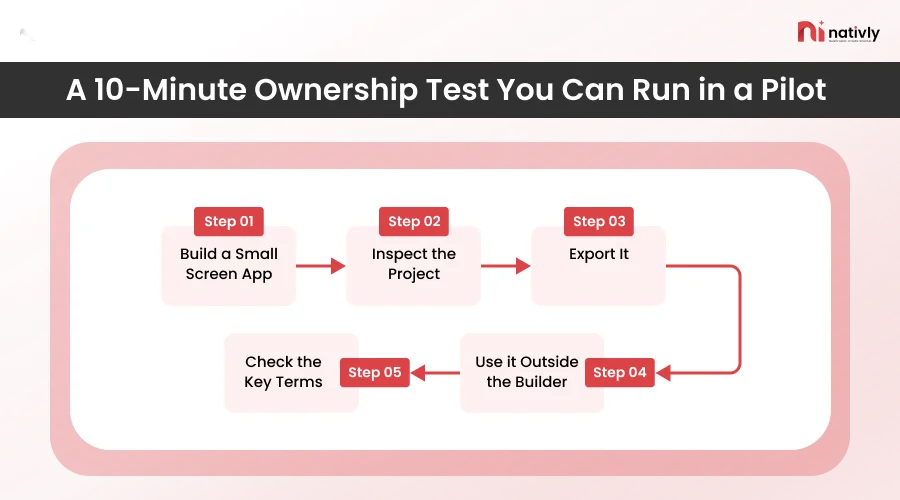
Step 1: Build a Small Screen App
The foremost step is to create a small screen app with a form and a saved record.
Step 2: Inspect the Project
Now, you should inspect the complete project, such as whether you can access the source code, repository, and other functions.
Step 3: Export It
Now, you should check whether the AI tool allows you to export the complete source code or not, along with full access to its functionality.
Step 4: Use it Outside the Builder
Open it outside the builder in a clean environment without any dependencies on the AI tools.
Step 5: Check the Key Terms
Check who owns the source code and data, what is licensed only, and whether the contract permits continued use after cancellation.
How Nativly Approaches Code and Data Ownership
Nativly is a leading AI app builder that offers the facility to build the complete app with the help of AI, and it allows you to connect with experts in case you face challenges building an app.
This is why Nativly is the right platform to build AI apps:
- Offers 100% Source Code Ownership: Users can push the code to GitHub.
- Independent Development and Hosting: Supports independent development and hosting by generating standard, exportable source code.
- Provides Native App Build: Nativly creates a real native app with simple prompts.
- AI Feature Generation: Feature spec from plain English description.
Conclusion
Having overall ownership of the code is possible only when the user checks all the possibilities before signing in to the app-building platform. Owning code access means having the legal right, technical access, and architectural control to modify the code and use it as per the owner’s flexibility.
When it comes to IP rights, users often ask about assignment rights, repository, and proprietary rights. Before you check in for an app-building platform, it’s important to test different aspects, including its build quality and how it allows source code export. And its independent functionality related to code exposure.
FAQs
1. Do I own code generated by an AI app builder?
Yes, you can own code generated by AI; you just need to consider two key factors: copyright law and the platform’s terms of service. You can test the app and its exporting feature by creating a simple sample or an MVP.
2. Can AI-generated code be copyrighted?
Purely AI-generated code cannot be copyrighted in most major jurisdictions because copyright law requires a human author. Additionally, code written end-to-end by an AI tool from a simple prompt lacks human expression. Even if specific base snippets generated by AI are unprotected, a project license can cover an entire software project.
3. Will an AI module train on my data?
It depends on the module’s terms and settings; hence, you need to confirm that your data is excluded from training and model improvement. Further, it depends on the provider, the product type, and your account settings.
4. What is IP indemnification, and does it cover AI output?
IP indemnification is a contractual promise where one party agrees to defend, reimburse, and hold harmless another party against third-party legal claims, losses, and damages arising from IP infringement.
5. Can I take my app and data elsewhere if I leave?
Whether you can take your app and data elsewhere depends on the platform, whether it is a cloud service/SaaS or a mobile app, and the terms of service of the provider.
6. Do I need a lawyer to review AI vendor terms?
You do not strictly need a lawyer for a casual first pass, but consulting a lawyer is strongly recommended for high-value, high-risk, or regulated AI vendor contracts.