Key Takeaways
- Enterprise AI use cases to create, design, and accelerate business applications.
- The enterprise use cases for AI builders include business process automation, customer portals and CRMs, industry-based AI app use cases, field service and inspection, and fraud detection.
- Connecting with Nativly can help enterprises to build apps that cater to their customized needs and turn their ideas into reality.
The next big app from your company does not start with complicated coding but with a simple prompt. Amazing, right?
But before you step into the enterprise AI app-building process, one of the key areas that you might be aware of is enterprise use cases for AI builders.
Learning about what AI builders are already offering to enterprises can help you to determine what can be best for your business.
Hence, we will walk you through the enterprise use cases for AI builders list that comprises how AI app builders are seamlessly lighting up the world of enterprises.
Let’s get it all started.
What is an Enterprise AI Tool for Building Apps?
An enterprise AI tool is a platform that uses artificial intelligence to create, design, or accelerate business applications while embedding strict governance, security, and compliance controls.
A user can prompt the AI tool with a plain-language description of the application. The system then generates an app that fits the chosen programming language or framework and the project’s requirements.
Additionally, an enterprise AI tool goes beyond UI generation, combining UI with business logic, data bindings, and deployments to build custom apps.
‘The three key components of an enterprise AI tool are:
- AI-Powered App Generation: In this component, the enterprise AI tool creates app screens, workflows, and business logic from a prompt.
- Data and Systems Integrations: The enterprise AI tool connects the app to the company’s databases, APIs, and other business systems.
- Security and Governance Controls: The enterprise AI tool manages user permissions and identity and may provide audit logs, along with controlled deployment options.
It is a platform that uses artificial intelligence to generate and accelerate business software from a natural language prompt.
Why Are Enterprises Turning to an AI Tool?
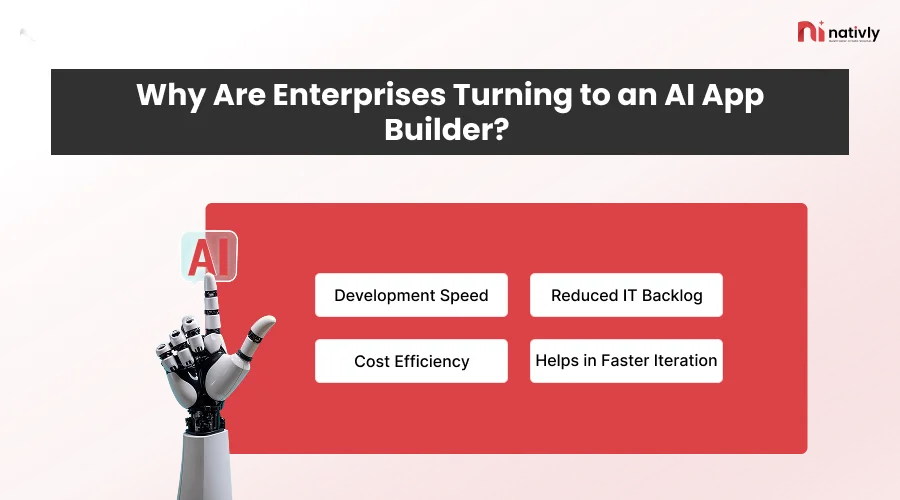
Enterprises are turning to AI tools to radically accelerate development cycles, shrink growing software, improve the speed of development cycles, reduce IT backlog, lower the cost per application, and help with faster iteration.
Building enterprise apps with AI is not a boring step; it is a strategic and smart step that enterprises should undertake.
Before you switch to the enterprise use cases for AI tools, it is important to identify the reasons why enterprises are turning to an AI tool.
Let’s cover it all in detail below:
-
Development Speed
One of the key benefits of why enterprises are turning to an AI tool is its development speed. A development team takes 2-3 months and sometimes up to 10 months to create an app from scratch.
However, when it comes to an AI builder, it takes a few minutes, hours, and sometimes a few days to create a complete app with the right features that you want.
-
Reduced IT Backlog
Enterprises need not worry about the IT backlog. Here, the department heads can build their own tools with the appropriate guardrails. The IT teams stop being the bottleneck for every internal software need.
The AI -powered development platforms do help in eliminating this bottleneck by shifting how the applications are built, deployed, and maintained.
-
Cost Efficiency
One of the key reasons that enterprises are turning to an AI tool is cost efficiency. In traditional development, you require high resources and capital to begin your business and to invest in it successfully.
When it comes to AI tools, the cost in comparison to app developers is low. Here, you are not paying the developers; you are paying the bot to use its services, and it creates a major difference.
-
Helps in Faster Iteration
Enterprise AI tools enable faster iteration through automating repetitive coding tasks, removing bureaucratic overhead, and using pre-built governance. When it comes to traditional development, a change request goes back into the queue.
While in an AI tool, iteration happens in the same session. This is important for enterprise use cases where the workflow still needs to be refined.
If you want to know the key differences between an AI tool and hiring a developer, here’s what you should know: AI Tool vs. Hiring a Developer.
Now, looking at the key reasons why enterprises are turning to an AI tool, it’s time to look at the enterprise use cases for AI tools in the following section.
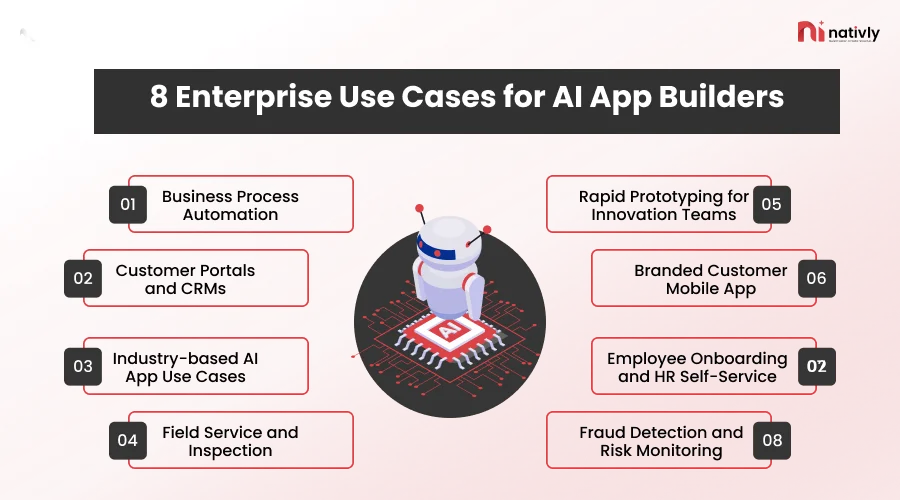
8 Enterprise Use Cases for AI Tools
The enterprise use cases for AI tools depend on several factors, such as translating natural language prompts, design files, and even workflows into functional software and automated systems.
Let’s study all the enterprise use cases for AI tools:
Use Case 1: Business Process Automation
The business process automation (BPA) powered by artificial intelligence moves enterprise workflows from static, rule-based scripts to dynamic, context-aware execution.
These builders are ideal for creating internal tools that streamline HR processes, project management, and client tracking.
Instead of forcing users to click through traditional rigid screens, AI tools use headless architecture, as well as contextual backends.
AI tools help you to generate custom customer portals and CRMs in minutes using natural language prompts instead of writing the complete code.
Use Case 2: Customer Portals and CRMs
The customer portals and CRMs do serve as a premier enterprise case study for AI builders because the enterprise bridges the complex data layers, multi-user permissions, and real-time automation into a tangible product that non-technical builders deploy rapidly.
Businesses can manage relationships, leads, and customer feedback by using an AI builder to create customized data systems within customer portals and CRMS that automate workflows.
Instead of forcing users to click through the traditional rigid screens, AI builders use headless architecture, as well as contextual backends.
AI builders help you to generate custom customer portals and CRMs in minutes using natural language prompts instead of writing the complete code.
Use Case 3: Industry-based AI App Use Cases
There are diversified industries, including education, logistics, and healthcare, that are using AI tools to create tailored solutions that address their unique operational needs.
Enterprise AI tools are applied across major industries to automate processes and unlock structured data.
Let’s evaluate how the enterprise use cases for AI builders differs as per the industries:
-
Education Industry
In the educational sector, enterprises and administrators can streamline student management and reporting.
-
Logistics Industry
Logistics enterprises use AI tools to optimize inventory management and delivery schedules. This industry uses AI and ML to automate workflows, lower fuel and labor costs, as well as orchestrate end-to-end supply chains.
-
Healthcare
Healthcare enterprises use AI tools for rapidly generating, customizing, and deploying internal tools and clinical workflows without writing any code from scratch.
-
Financial Services
Financial services enterprises use AI tools to rapidly deploy secure, compliant apps to create applications that automate tasks such as reviewing documents, supporting fraud and risk management.
-
Manufacturing & Industrial
Manufacturing and industrial organizations use artificial intelligence (AI) to automate operations, minimize downtime, and optimize supply chains. These enterprises shift from slow, traditional software development to rapid agentic AI platforms that bridge IT and OT.
-
Software Development & IT
Software development and IT enterprises use AI tools to speed up the prototyping and app creation, and to generate code and workflows. It further helps developers to spend time on complex design, security, and quality checks, while teams still review and test generated apps.
Use Case 4: Field Service and Inspection
Field service and inspection is a high-value enterprise use case for the AI builders.
Enterprises use AI builders to create mobile inspection and service apps that guide workers through checklists, capture photos and notes, generate reports, and route failed checks.
Field service and inspection is a high-value enterprise use case that replaces slow, error-prone manual forms with digital workflows.
This is an important enterprise use case for AI tools because it guides the workers through checklists, captures photos and notes, and routes failed checks or even repair requests to the right team.
Use Case 5: Rapid Prototyping for Innovation Teams
Rapid prototyping for innovation teams is a core enterprise use case for AI builders because it compresses the product discovery processes and validation cycles from weeks to hours and days.
This prototyping is a modern product development methodology focused on quickly fabricating a scale model or functional version of a product-often using computer-aided design tools as well as automated manufacturing technologies.
Whether it’s an enterprise or a startup, they demand rapid prototyping to efficiently turn abstract concepts into testable, tangible models quickly and sharply.
It offers faster time-to-market, helps with cost reduction, early validation, better cross-team collaboration, and encourages experimentation.
Use Case 6: Branded Customer Mobile App
Enterprises use branded customer mobile apps built with AI tools, enabling companies to rapidly deploy tailored, customer-facing mobile experiences with embedded intelligence.
These mobile apps built via enterprise AI tools allow organizations to deploy tailored, data-integrated digital solutions without any heavy traditional coding.
These enterprise use cases for AI tools allow organizations to rapidly prototype, deploy, and scale tailored digital solutions while keeping strict brand identity and backend integrations intact.
Use Case 7: Employee Onboarding and HR Self-Service
The critical need for enterprise use cases for AI tools is due to scattered forms, emails, and repeated follow-ups.
Here, employee onboarding and HR self-service do represent high-value enterprise use cases, as it is all about using AI tools to automate, personalize, and support tasks across the preboarding and onboarding processes.
Employee onboarding and HR self-service is a layer of intelligence that you can weave into the existing HR workflows, systems, and tools to create tailored experiences.
These are the foundational use cases for AI tools because they target high-volume, repetitive, and administrative-heavy internal processes.
Use Case 8: Fraud Detection and Risk Monitoring
Fraud detection and risk monitoring is a key enterprise use case for AI tools because it bridges real-time system performance, regulatory trust, and financial protection.
It is an important use case because they replace slow, manual, rule-based checks with automated, real-time intelligence.
The AI tools power fraud detection via real-time risk data analysis, pattern recognition and anomaly detection, adaptive learning, and decision-making.
The core pillars include behavioral biometrics, explainable AI, and model drift monitoring.
Here is the summary of the enterprise use cases for AI tools:
| Use case | Pain point | Core features | Sample prompt idea | |
|
1 |
Field inspection and maintenance | Paper checklists, delayed reports | Photo capture, GPS, signatures, checklists | “Field inspection app with checklist, photos and manager sign-off” |
|
2 |
Employee onboarding and HR self-service | Scattered forms and emails | Task lists, document upload, leave requests | “Onboarding app with tasks, documents and a manager approval flow” |
|
3 |
Safety, incident and compliance reporting | Slow, inconsistent reporting | Incident forms, push alerts, audit trail | “Incident reporting app with photo evidence and supervisor alerts” |
|
4 |
Inventory, warehouse and asset tracking | Manual counts, stock errors | Barcode scanning, stock updates | “Warehouse app that scans barcodes and logs stock movement” |
|
5 |
Field sales and order capture | Offline notes, lost leads | Visit logs, catalogs, quotes | “Sales rep app with customer visits, product catalog and orders” |
|
6 |
Branded customer app | Generic third-party portals | Booking, loyalty, support chat | “Customer app for service booking with reminders and loyalty points” |
|
7 |
Partner, dealer or vendor portal | Email and spreadsheet back-and-forth | Order status, documents, messaging | “Dealer app with order tracking and document sharing” |
|
8 |
Approvals, expenses and mobile dashboards | Managers blocked at desks | Receipt capture, approvals, KPI views | “Expense app with receipt scanning and manager approval” |
If you are ready to begin and are finding one motivating idea, here is the complete list to discover the top 10 ideas you can build with an AI builder.
How Nativly Helps from Prompt to Production App
Nativly is the best AI builder platform for enterprise app development. This platform allows enterprises to evaluate their ideas and then convert them into reality with a simple prompt.
This is why to connect Nativly as an AI:
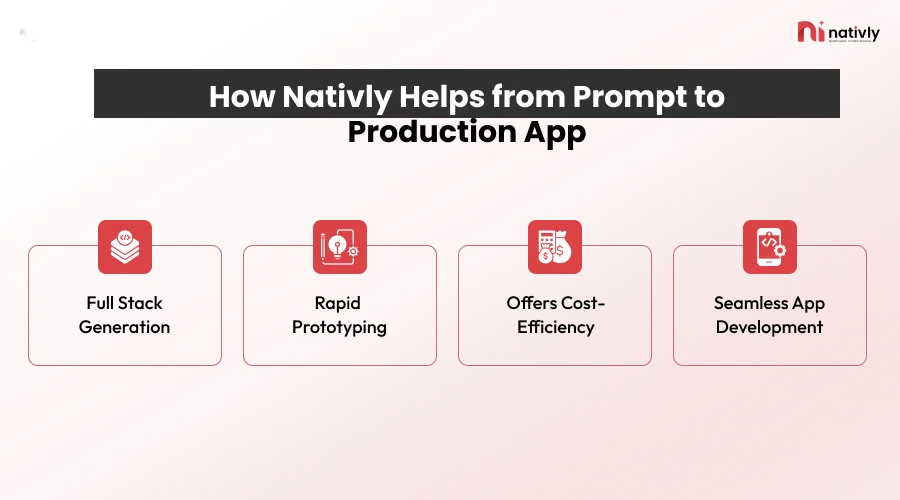
1. Full Stack Generation
Nativly is a platform that offers full-stack generation, which means that the tool creates a complete, working software application from a visual mock-up and a simple language prompt.
2. Rapid Prototyping
With its effectiveness, Nativly quickly creates apps that function well on the App Store and Android platforms. Here, users can generate apps that can run on the mobile device’s hardware using actual code.
3. Offers Cost-Efficiency
Nativly has the best reasonable pricing to build an app with AI, ranging from $19/month to $199/month. In case of an enterprise app, it starts at $199 per month. You can also avail for the custom quote. We do offer a complete source code transfer certificate to the users.
4. Seamless App Development
Nativly transforms plain text into apps that help enterprises and startups to convert their ideas into reality without any coding. Furthermore, it combines conversational AI with an automated pipeline.
Conclusion
The key enterprise use cases for AI tools are related to what these AI tools are doing for enterprises in different streams and industries.
AI tools for enterprises offer business process automation, where they can create a complete tool for streamlining different tasks and operations at the management level. These builder services for customer portals and CRMs serve as an ultimate solution model for creating portals that can be responsive to users.
Other than this, enterprise AI tools offer diversified industry-based solutions for the education industry, logistics, healthcare, financial services, manufacturing, and software development.
These builders offer employee onboarding, fraud detection, and branded customer mobile app solutions. Thus, connecting with the right AI tool is a solid deal at this place.
FAQs
Q1. What is an enterprise AI tool?
An enterprise AI tool is a platform that lets users create software applications using natural language prompts, AI code assistance, and visual editors, along with governance controls required by large organizations.
Q2. What can enterprises build with AI?
Enterprises with AI tool can create prototypes, MVPs, and a complete app that too, with natural language prompts. They can use the visual low-code and no-code interfaces and even AI-assisted coding with the help of an enterprise AI tool.
Q3. Can an AI tool create production-ready enterprise software?
Yes, an AI tool for enterprises can create production-ready enterprise software. With the help of native language prompts, these AI tools can help the enterprises to create a secure and, production-ready enterprise software successfully.
Q4. Is a native app better than a web wrapper for enterprise use?
Native apps suit needs like offline access and deeper device integration. Web wrappers can be quicker to build when a mobile version of an existing website is enough.
Q5. Do I own the source code that an AI tool generates?
That depends on the builder and plan. Check the contract for code ownership, export rights, and whether you can maintain the app independently.
Q6. How much does it cost to build an enterprise app with Nativly?
The overall cost to create an enterprise app with Nativly is $199/month. Enterprises can find various benefits of selecting this plan, such as a native iOS and Android app built, APK download and GitHub export, and App Store and Play Store publishing.
Q7. Can I publish the app to the App Store and Google Play?
Nativly supports publishing to both stores, subject to their review and approval processes. You’ll need developer accounts.
Q8. How should an enterprise start with an AI tool?
Pick a small, low-risk workflow for a pilot. Test integrations, security, compliance, maintenance, and costs before expanding to production.